
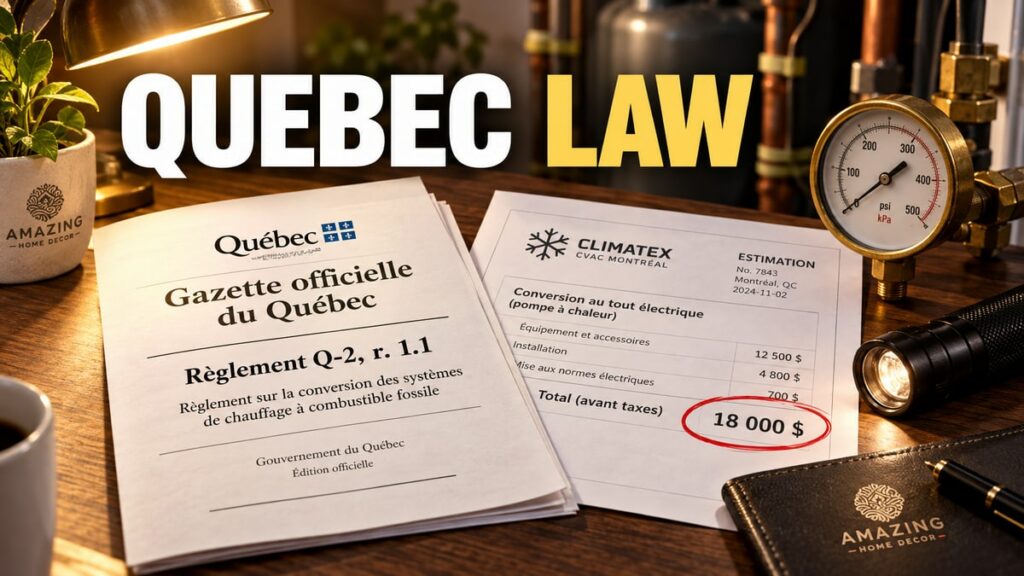
If Your Oil Furnace Dies This Winter, Quebec Law May Force You to Convert It
A viral post claims every oil-furnace repair is now illegal. The real rule is narrower, and for thousands of aging Montreal homes, it lands the same way: a breakdown turns into a forced conversion, timed by luck in the coldest weeks of the year.
It is mid-January, minus twenty outside, and the furnace in your duplex stops making warm air. A technician opens the panel and finds a cracked heat exchanger. You expect a bill around $900 and a day without heat. Instead you get a sentence most Quebec homeowners have never heard: that part cannot legally be repaired, and the furnace cannot be replaced with another oil furnace. Your next step, by law, is an electric conversion that contractors in Montreal currently price between roughly $13,000 and $26,000 before taxes and grants.
It is the plain effect of Quebec’s Regulation respecting oil-fired heating appliances (Q-2, r. 1.1), which took full effect on December 31, 2023, and it sits on top of a grant system that collapsed this year. Last winter, an owner in this situation could stack up to about $11,000 of government help. As of this fall, most of that money is gone, the heating-oil price in Montreal has climbed about 41 per cent above last season’s average, and contractor books fill the moment the first cold snap hits.
What the law bans, and what it still allows
The regulation applies to residential buildings of 600 square metres or less and up to three storeys, which covers nearly every bungalow, duplex and triplex in the city. Oil heating has been banned in all new Quebec construction since December 31, 2021, and since December 31, 2023, three more rules apply to existing buildings. Installing oil equipment is prohibited. Replacing an oil furnace or boiler with anything that burns a fossil fuel (oil, natural gas, propane) is prohibited. And repairing oil furnaces and boilers installed more than 20 years ago, and oil water heaters installed more than 10 years ago, is prohibited, with defined exceptions.
The exceptions matter, because they decide which repairs stay legal. Normal maintenance per the CSA B139 installation code remains legal at any age, and so do repairs to motors, motor-driven moving parts, and electronic components tied to operation and safety controls. What the regulation removes, in every case, is the combustion chamber and the heat exchanger:
So the viral contractor post circulating on social media, which states flatly that “you are no longer allowed to repair an oil furnace or boiler,” is only half right. A technician can still legally fix a blower motor or a control board on your 12-year-old furnace. But the failures that strand a house in January, the cracked heat exchanger, the burnt combustion chamber, sit on the banned list regardless of the unit’s age. And once a furnace or boiler passes the 20-year mark, or a water heater passes 10, the repair ban widens to everything except routine maintenance, motors, and control electronics. Violations carry administrative and penal sanctions under the Environment Quality Act, and the licensed professional who performs the work faces declaration obligations of their own.
Replacement must run on electricity or another renewable source. This is the forced conversion.
The trap is widest in exactly these homes
Between 145,000 and 200,000 Quebec households still heat with oil, depending on the count and the year: the provincial industry cited close to 200,000 when the regulation was announced, and CTV reported more than 145,000 homes still on oil when it examined the 2030 target. Montreal’s housing stock is precisely where the rule bites hardest. The city’s pre-1960 duplexes, triplexes and wartime houses are old enough that most of their original heating equipment is long past the 20-year repair line, and many carry mixed baseboard-plus-furnace layouts that complicate any conversion quote. The city itself estimated several thousand homes still on oil when it promised, in 2019, that “by 2030, the use of heating oil in Montreal will be over,” and it has since banned combustion heating in new buildings as of October 2024 for smaller projects and April 2025 for larger ones. The provincial regulation is what binds your existing home today; the city’s 2030 target is the direction of travel.
The cost of staying put rose sharply this year. The Régie de l’énergie’s weekly survey shows Montreal heating-oil prices climbing almost every month of 2026 into the heating season:
Every month of waiting costs more than the one before it, and the wait can end in a mid-winter emergency. Canada’s federal government, announcing its new heat-pump rebate this month, put the breakdown pattern in numbers: about one million Canadian homes replace their heating system every year, and more than 80 per cent of the time it is because the old system failed without warning.
The money just ran out
The grant stack that made conversions affordable was dismantled piece by piece between March and July of this year, just before the season when furnaces fail.
Oil heating banned in all new Quebec residential construction.
Existing buildings: no oil installs, no fossil-fuel replacements, repair ban by equipment age. The forced-conversion rule begins.
Chauffez vert closes. The provincial oil-conversion grant ($1,275 for a single-family home, $250 more for the water heater) stops accepting applications.
Hydro-Québec’s free heat-pump offer for low- and modest-income households fills its 20,000 spots for 2026-27 and closes registrations.
The federal oil-to-heat-pump program (CAMT), worth up to $10,000 to income-eligible households, closes applications.
Ottawa announces a National Heat Pump Rebate: $2,000 for eligible households, up to $10,000 below median income, stackable with provincial programs, with promised 24-hour approvals. The online portal is not live yet.
Montreal’s target date to end residential oil heating entirely.
Program | Who pays | Amount | Status on Oct 16, 2026 |
|---|---|---|---|
Chauffez vert (oil conversion) | Government of Quebec | $1,275 single-family; $875 per plex unit; +$250 water heater | Closed Mar 31, 2026 |
CAMT / Oil to Heat Pump Affordability | Government of Canada | Up to $10,000, income-tested | Closed Jul 31, 2026 |
Free heat pump (Éconologis offer) | Hydro-Québec | Full install, low- and modest-income | 2026-27 spots filled Jul 30 |
LogisVert Efficient Homes | Hydro-Québec | Up to $6,700 for an eligible heat pump; calculated per 1,000 BTU/h of capacity at -8°C; +5% when combined with another measure; plex bonus in designated zones since June 2026 | Open |
National Heat Pump Rebate | Government of Canada | $2,000; up to $10,000 below median income; stackable with provincial aid | Announced Oct 8, portal pending |
If your furnace died last January, an income-eligible household could still reach the federal CAMT program for up to $10,000 and add the provincial $1,275. This January, the realistic stack is the LogisVert rebate plus, eventually, the new federal rebate once its portal opens. The system now punishes the same breakdown far more than it did a year ago.
The two winters: planned versus emergency
Planned conversion, this month
- Base cost (central system with heat pump)
- $13,000 to $26,000 before taxes, per Montreal 2026 market pricing
- Grants reachable
- LogisVert up to $6,700; federal $2,000+ rebate when the portal opens
- Contractor choice
- Two or three competing quotes, scheduled at your convenience
- House stays warm
- Yes: the old system runs until the new one is commissioned
- Oil deliveries meanwhile
- None needed beyond the season you choose
Emergency conversion, mid-January
- Base cost
- Same $13,000 to $26,000, plus whatever a cold-snap market bears: whoever is free is whoever you hire
- Grants reachable
- Same on paper, but applications compete with a city’s worth of breakdowns, and rebate processing continues after the heat is back
- Contractor choice
- n/a: waitlists rule; rush jobs rarely get compared
- House stays warm
- Portable electric rental heaters or hotel nights for days to weeks, depending on queue depth
- Oil deliveries meanwhile
- n/a: no furnace to feed
The planned route also pays you back every year after. Federal figures put average savings at $1,400 a year for households leaving oil or electric baseboards for a heat pump, and NRCan estimated $1,500 to $4,500 a year for an oil-boiler home moving to a cold-climate heat pump. Against Montreal’s current oil price, every winter spent on oil is the most expensive heating decision available in this province, where electricity rates are among the lowest in North America.
Buy back your options before January
- Find your equipment’s age. The data plate on the furnace, boiler or water heater usually carries a manufacture or install date. Under 20 years for a furnace or boiler, under 10 for a water heater, and minor repairs stay legal. Over those lines, treat this season as your last on oil.
- Book a fall tune-up now. A certified technician (CMMTQ members are the trade body for this work) can tell you what the unit’s condition implies about its odds of surviving January, and normal maintenance is explicitly permitted.
- Get conversion quotes while slots exist. Ask each bidder for the equipment’s certified capacity at -8°C, the number that drives the LogisVert payout, and check the model against Hydro-Québec’s eligible heat pump list before you sign anything.
- Pick cold-climate certified equipment. The LogisVert formula pays much more per 1,000 BTU/h at -8°C for ENERGY STAR cold-climate units than for standard ones, and cold-climate units are the ones that carry a Montreal January.
- Watch the federal portal. The National Heat Pump Rebate announced October 8 promises approval within 24 hours and stacks with provincial aid. When the portal opens, include it in your quote comparisons.
- If you rent out the plex, do the math on the lease. A heat pump installed by the owner becomes part of the leased equipment: you maintain it and eventually replace it, while rent increases tied to major work are capped. Landlord groups have been saying for years that the conversion burden lands on owners with limited rent levers; budget for the lifetime of the machine, not just the install.
- Call your insurer if anything changes. Current guidance from Promutuel is that the regulation alone does not alter home coverage, but a new heating system should be declared, and a breakdown you cannot legally repair will not be treated as an insurable fix.
Sources
- Regulation respecting oil-fired heating appliances (Q-2, r. 1.1), LegisQuebec, current to June 1, 2026.
- Chauffage au mazout résidentiel, Gouvernement du Québec, updated June 8, 2026 (rules, exceptions, maintenance).
- Chauffez vert: aide financière pour le retrait d’un système au mazout ou au propane, Gouvernement du Québec, updated March 31, 2026 (program end) and amounts page, March 30, 2026.
- Quebec phases out use of fuel oil for residential buildings, Mechanical Business, November 2, 2023.
- Quebec announces the phase-out of residential oil-fired heating systems, HRAI In the Air (citing the Montreal Gazette’s figure of nearly 200,000 households).
- Plante says Montreal will ban oil furnaces by 2030, Montreal Gazette, May 2019.
- Montreal ban on gas/oil-powered heating systems in new buildings, IEA policy database (October 2024 / April 2025 dates).
- Relevé hebdomadaire des prix, mazout léger, Régie de l’énergie, week of October 12, 2026.
- High demand fills Hydro-Québec’s free heat pump offer for 2026-27, CityNews Montreal, July 30, 2026.
- Programme pour la Conversion abordable du mazout à la thermopompe (CAMT), Ressources naturelles Canada (closed July 31, 2026).
- Prime Minister Carney announces landmark investment to retrofit one million homes, PMO, October 8, 2026 (National Heat Pump Rebate; 80% breakdown statistic).
- LogisVert Efficient Homes Program participant’s guide, Hydro-Québec, v1.10, September 15, 2026, and the LogisVert program page (archived February 17, 2026; up to $6,700 for an efficient heat pump).
- Oil-to-electric heating conversion: real costs in Quebec 2026, RenoQuotes, June 15, 2026.
- New oil heating regulations: how do they affect your home insurance?, Promutuel Assurance, January 2024.